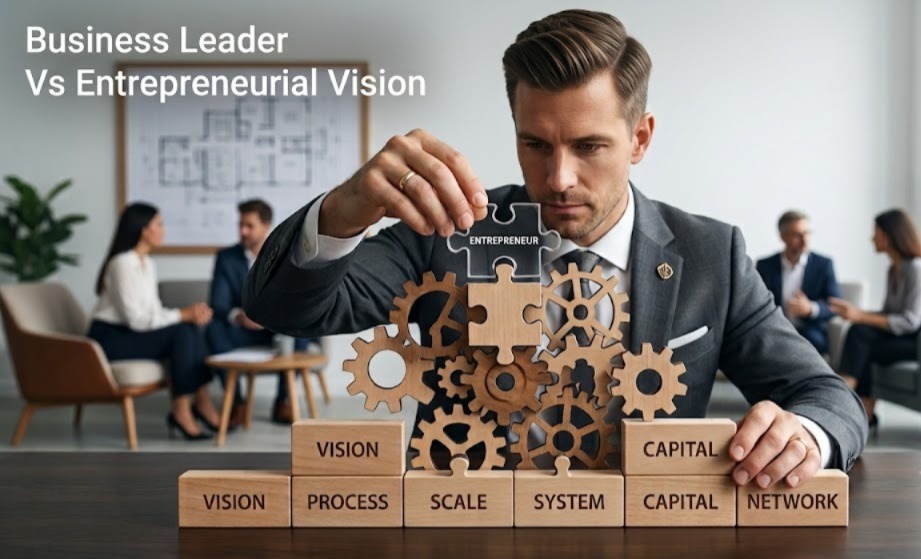
The entrepreneurial journey is demanding. It requires vision, resilience and an unyielding commitment to turning ideas into reality. Yet within the business world, two distinct profiles often emerge: the entrepreneur and the business leader. Though the terms are frequently used interchangeably, they represent different mindsets, ambitions and stages in the business lifecycle.
Understanding these differences is essential for professionals seeking to clarify their career paths and for organisations aiming to foster the right talent for the right roles.
Defining the Entrepreneur
An entrepreneur is someone who identifies a business opportunity and takes the risk of transforming it into reality. This profile is defined by innovation, a relentless drive to explore new ideas and a willingness to face the challenges inherent in launching a venture.
Entrepreneurs are not solely motivated by financial gain. They are driven by passion and a commitment to their vision. They see possibilities where others see obstacles and are willing to challenge established norms.
A recent report on the entrepreneurial landscape reveals that the proportion of new entrepreneurs in the United States has increased, with entrepreneurial activity remaining significantly higher than pre-pandemic levels. This surge reflects a broader cultural shift toward independent value creation, a trend that resonates with the purpose-driven approaches that many modern founders now champion.
The Role of the Business Leader
The business leader, by contrast, is someone who manages and guides an established organisation. This profile focuses on growth, stability and profitability, directing efforts toward improving efficiency and maintaining competitive advantage.
Business leaders face challenges related to resource management, market expansion and innovation within the confines of their industry. Their success depends on management, strategic planning and decision-making skills.
A study on entrepreneurial alertness reveals that individuals who are more alert to business opportunities often make different career choices than those who are not. This alertness, characterised by an ability to see patterns and opportunities where others do not, is a hallmark of the entrepreneurial mindset.
Diverging Skill Sets
While both profiles share qualities such as determination and leadership, the specific skills that define each are distinct. The entrepreneur must be highly adaptable, quick to learn from mistakes and comfortable with significant risk. The business leader must excel in management, strategic analysis, team leadership and resource optimisation.
A comparative analysis of graduates from different educational backgrounds found that those with entrepreneurial education are more likely to start businesses, but they also exhibit the managerial skills necessary for leading those businesses effectively. This suggests that while the entrepreneurial spark is essential, the ability to lead and manage is what transforms a startup into a sustainable enterprise.
Risk and Resilience
Launching and leading a business involves different kinds of risk. For the entrepreneur, the primary risk lies in the uncertainty of the project’s success. The business leader faces the challenge of maintaining relevance and a competitive edge in a constantly evolving market.
Both figures must be ready to adapt, learn continuously and remain resilient when confronted with setbacks. This capacity to grow from failure is a common thread that runs through both profiles, yet it manifests differently depending on the stage and nature of the venture.
Shifting Goals
Although both entrepreneurs and business leaders share a desire to succeed, their ambitions often diverge. The entrepreneur aims toward creation, innovation and the social or environmental impact of their project. The business leader focuses on sustained growth, profitability and consolidating the organisation’s market position.
Recent data shows that new entrepreneurs are more likely to report that starting a business was a necessity rather than an opportunity, indicating that economic pressures are driving many to entrepreneurship. This necessity-driven entrepreneurship often leads to a focus on survival and short-term viability, which can differ from the long-term strategic orientation of established business leaders.
Complementarity, Not Hierarchy
The differences between entrepreneurs and business leaders do not imply a hierarchy of value or importance. Rather, they reflect different focuses, ambitions and stages in the business lifecycle. The entrepreneur’s drive to create and innovate complements the business leader’s ability to scale and sustain.
Knowing which profile you identify with can help clarify your professional path and the steps you should take. Whether it is innovating with a new business idea or leading an established company, understanding where your strengths lie is essential for long-term success.
The most successful organisations often combine the entrepreneurial spark with disciplined business leadership. They foster innovation while maintaining operational excellence, creating environments where both creators and managers can thrive. This is the foundation of institutional resilience.