
In a rapidly changing global economy, leadership is being redefined. The leaders of tomorrow must not only be innovative and visionary but also deeply ethical. They must navigate technological disruption, global competition, and social complexity without losing their moral compass.
This is where the concept of ethical entrepreneurship becomes essential — it unites creativity and conscience, ensuring that innovation serves humanity rather than exploiting it. At the Institute of Leadership, Entrepreneurship, and Corporate Governance (INSLEC), developing ethical and entrepreneurial leaders has become a core mission — shaping professionals who lead with integrity and innovation.
1. The Moral Dimension of Leadership
Leadership without ethics is unsustainable. History is filled with examples of talented leaders and entrepreneurs whose success collapsed under the weight of ethical failure. Ethical lapses — corruption, exploitation, or dishonesty — do not just damage reputations; they destroy trust, and trust is the foundation of every effective institution.
According to a 2023 Deloitte Global Human Capital Trends Report, 74% of employees say they are more likely to stay with organizations that demonstrate strong ethical leadership. This data underscores a timeless truth: values drive loyalty and performance.
Ethical leadership is not about perfection; it’s about accountability and transparency. It involves making difficult decisions with integrity, even when no one is watching. For INSLEC, the starting point of professional excellence is moral excellence.
2. The Entrepreneurial Leader: Beyond Profit
Entrepreneurship, at its best, is not only about generating wealth — it’s about generating value. True entrepreneurs solve problems, create jobs, and improve quality of life. Yet, the drive for profit can sometimes overshadow the commitment to purpose.
Entrepreneurial leaders who embed ethics into their decision-making processes redefine what success means. They move from a mindset of extraction (“How much can I gain?”) to a mindset of contribution (“How much can I create and give?”).
INSLEC’s training approach blends entrepreneurship with leadership ethics, teaching that profitability and responsibility are not opposites but partners. The ethical entrepreneur is both visionary and accountable — leading with integrity and creating sustainable impact.

3. Why Ethics and Entrepreneurship Must Coexist
The connection between ethics and entrepreneurship is not optional — it’s strategic. Research by the World Economic Forum (2022) shows that businesses built on strong ethical foundations outperform peers in long-term sustainability and investor trust.
When leaders act ethically, they attract collaborators, investors, and customers who share their values. Ethical entrepreneurship builds reputational capital — an invisible yet powerful asset that strengthens resilience in times of uncertainty.
Moreover, ethics fosters innovation. A transparent and fair culture encourages people to share ideas, take risks, and challenge assumptions without fear of exploitation. Ethical organizations innovate faster because their people trust the system.
4. INSLEC’s Approach to Ethical and Entrepreneurial Leadership
INSLEC’s framework for leadership development integrates three interconnected dimensions:
- Leadership – cultivating character, vision, and accountability.
- Entrepreneurship – promoting innovation, problem-solving, and value creation.
- Corporate Governance – establishing systems for transparency and ethical management.
Through workshops, certification programs, and institutional partnerships, INSLEC nurtures leaders who balance innovation with governance and ambition with integrity.
INSLEC’s student and professional membership programs are designed to develop these skills early. From undergraduates to executives, participants learn how to turn ideas into action responsibly.
5. The Role of Emotional and Moral Intelligence
Modern leadership requires more than technical skill. It demands emotional intelligence (EQ) and moral intelligence (MQ) — the capacities to empathize, reflect, and act according to ethical principles.
- Emotional Intelligence (EQ) helps leaders connect authentically with people, build trust, and lead teams effectively.
- Moral Intelligence (MQ) helps leaders make principled choices in complex environments.
A 2022 study by Harvard Business Review found that leaders who combine EQ and MQ are 30% more effective at managing change and driving innovation. These insights reinforce INSLEC’s holistic model of leadership — one that balances heart, mind, and action.
6. Ethical Entrepreneurship and National Development
Developing ethical and entrepreneurial leaders is not just an organizational goal; it’s a national imperative. Societies thrive when innovation aligns with justice, accountability, and service.
Countries that prioritize ethical entrepreneurship see higher levels of inclusive growth and lower levels of corruption. According to the Transparency International Corruption Perceptions Index (2023), nations that invest in ethics education and good governance record stronger economic performance and citizen trust.
INSLEC envisions this transformation for Nigeria and beyond: building a cadre of leaders who view enterprise as service — not exploitation — and who see governance as stewardship, not control.
7. The Path to Becoming an Ethical Entrepreneurial Leader
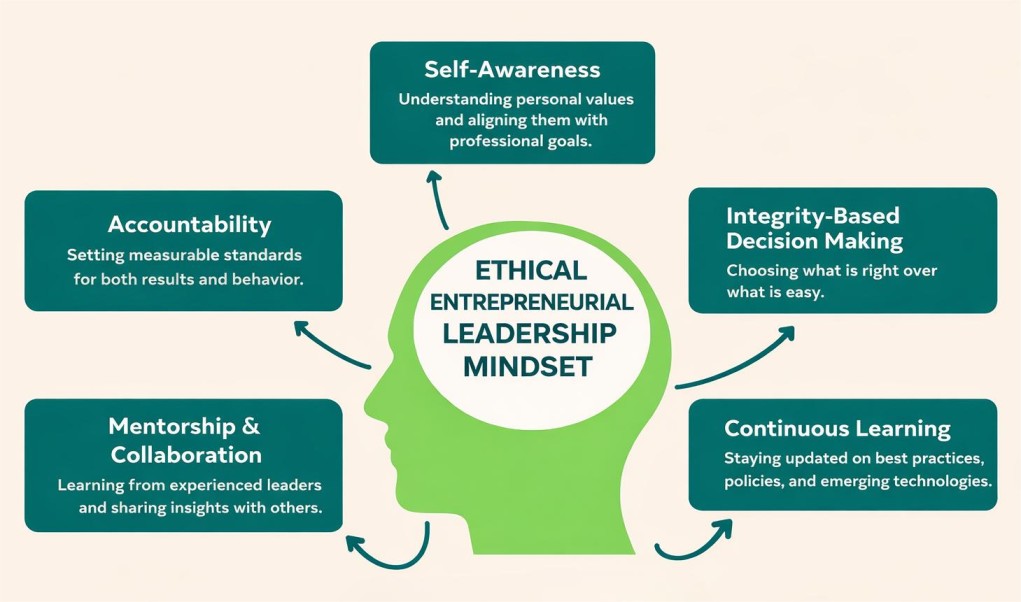
Ethical and entrepreneurial leadership is cultivated through deliberate steps:
- Self-awareness – Understanding personal values and aligning them with professional goals.
- Integrity-based decision making – Choosing what is right over what is easy.
- Continuous learning – Staying updated on best practices, policies, and emerging technologies.
- Mentorship and collaboration – Learning from experienced leaders and sharing insights with others.
- Accountability – Setting measurable standards for both results and behavior.
INSLEC’s membership and certification programs are structured around these principles — ensuring that every participant not only gains professional competence but also moral clarity.
8. The INSLEC Ethos: Leadership with Purpose
INSLEC’s mission is to transform leadership across Africa and the world through ethics-driven entrepreneurship and governance. The institute believes that every leader, regardless of sector, holds the potential to influence society positively when guided by purpose and values.
Ethical and entrepreneurial leadership creates ripple effects — better organizations, stronger economies, and more just communities. INSLEC continues to invest in this vision by offering structured learning pathways that empower individuals to lead with conscience and competence.
9. Conclusion: The Future Belongs to Ethical Innovators
As technology accelerates and society evolves, the gap between innovation and morality must not widen. The future belongs to ethical innovators — leaders who use their creativity to uplift others, not exploit them.
Ethical and entrepreneurial leaders will shape a generation of professionals who build value, uphold integrity, and inspire trust. They will be the foundation upon which institutions, economies, and nations thrive.
INSLEC remains committed to nurturing these leaders — men and women who transform vision into virtue, and enterprise into enduring legacy.