

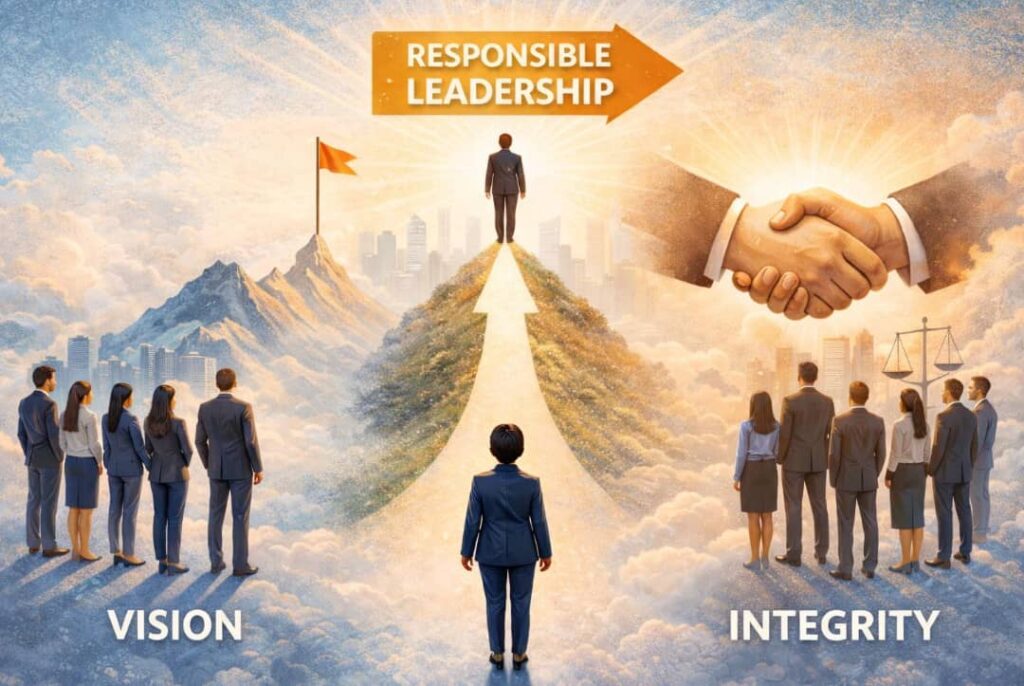
Leadership begins with vision, but it endures through integrity. A clear vision inspires people to move forward; integrity keeps them together when the journey becomes difficult. Responsible leadership is therefore not built on talent alone — it is sustained by trust, accountability, and moral courage.
In a world facing uncertainty and rapid change, the need for responsible leaders has never been greater. Across organizations, communities, and nations, people are searching for individuals who can translate vision into ethical action. This is the foundation of responsible leadership — leading with foresight, guided by principles that protect both people and purpose.
1. Vision: Seeing Beyond the Present
Every transformation begins with vision. Vision gives direction, meaning, and energy to leadership. It allows leaders to see possibilities that others overlook and to inspire others toward a better future.
However, vision without integrity becomes illusion. History is filled with leaders who had grand ideas but lacked the moral strength to execute them responsibly. Vision must therefore be connected to values — the ethical framework that determines how goals are pursued.
A visionary leader asks not only “What can we achieve?” but also “How should we achieve it?” This question distinguishes responsible leadership from ambition without conscience.
2. Integrity: The Anchor of Leadership
Integrity is often described as doing the right thing even when no one is watching. For leaders, it means consistency between words and actions, between personal values and public behavior. Integrity turns authority into credibility.
Without integrity, vision loses legitimacy. People may follow a charismatic leader for a season, but they will not trust one who lacks honesty and transparency. Integrity is what converts followers into partners and teams into communities.
Responsible leaders understand that every decision — large or small — communicates values. They accept accountability for outcomes and take responsibility for mistakes. This commitment builds the kind of trust that cannot be commanded; it must be earned.
3. The Link Between Vision and Integrity
Vision and integrity are not separate qualities; they are interdependent. Vision provides purpose, and integrity provides direction. Together, they form the moral compass of leadership.
A leader with vision but no integrity may achieve short-term results but will eventually lose credibility. A leader with integrity but no vision may be respected but will not inspire progress. Responsible leadership requires both — the imagination to dream and the discipline to do right.
At the Institute of Leadership, Entrepreneurship and Corporate Governance (INSLEC), this philosophy is at the core of leadership education. The institute trains professionals to think boldly while acting ethically, ensuring that innovation always aligns with accountability.
4. The Principles of Responsible Leadership
Responsible leaders cultivate a set of guiding principles that shape their decisions and relationships. These include:
- Transparency – communicating openly and honestly with stakeholders.
- Accountability – accepting responsibility for actions and outcomes.
- Empathy – understanding the impact of decisions on others.
- Fairness – ensuring that opportunities and rewards are distributed justly.
- Courage – standing by ethical convictions even under pressure.
These principles transform leadership from a position of power into a platform for service.
5. Building Responsible Leadership in Organizations
Organizations thrive when responsible leadership becomes part of their culture. This requires more than policies; it requires consistent behavior from the top down.
Leaders must model ethical standards, encourage feedback, and recognize integrity as a key performance indicator. Training programs should focus not only on skills but also on values — helping employees understand that ethical conduct is a shared responsibility.
INSLEC’s leadership and corporate governance programs emphasize this holistic approach. By integrating vision, integrity, and accountability, institutions can build resilience, inspire trust, and achieve long-term sustainability.
6. The Role of Self-Awareness
Responsible leadership begins with self-awareness. Leaders who understand their strengths, weaknesses, and motivations are better equipped to act with integrity. Self-awareness promotes humility, which keeps ambition in balance and prevents misuse of power.
Reflective practices such as journaling, mentorship, and feedback sessions help leaders remain grounded. They learn to ask difficult questions: Am I leading for recognition or for impact? Am I consistent in my values? This kind of inner honesty is the starting point of external integrity.
7. Leading Through Example
The most powerful form of leadership is example. Responsible leaders do not merely communicate standards; they embody them. They demonstrate punctuality, honesty, and respect in every interaction. Their behavior becomes the template for others to follow.
When leaders lead through example, they create a culture where integrity is normal, not exceptional. Employees begin to internalize these values, and organizations become self-governing communities rather than rule-driven bureaucracies.
8. The Legacy of Responsible Leadership
The true measure of leadership is not in titles or achievements but in legacy — the lasting influence a leader leaves behind. Vision may set direction, but integrity determines how far that vision travels through generations.
Responsible leaders leave behind strong institutions, empowered people, and sustainable systems. They prove that leadership is not about control but about contribution. Their vision is remembered not for its ambition but for its honesty.
Conclusion: Walking the Pathway of Responsible Leadership
The pathway to responsible leadership is a lifelong journey from vision to integrity. It demands clarity of purpose, strength of character, and dedication to ethical practice.
As INSLEC continues to develop leaders across sectors, the message remains clear: the future belongs to those who can see beyond the present and act with integrity in every circumstance.
Vision lights the way; integrity keeps the path straight. Together, they form the essence of leadership that endures.